The Tool Collection Trap: Buying Before You Know the Job
A task-first approach to buying tools helps beginners choose what to borrow, improvise safely or own for a small household project.
The common mistake with a first household project is buying a tool before deciding what the job actually asks of it. The tool collection trap leaves a beginner with a drawer of unfamiliar kit, while the project still depends on choosing the right material, making a careful mark or holding a piece steady. Start with the task, then choose what will help you do it.
For a small, non-hazardous project, there are three sensible routes: borrow a suitable tool, use a safe substitute already at hand, or buy something you expect to reach for again. None is automatically the thrifty or capable choice. The useful question is whether the tool solves a specific problem in this job, and whether you can use it with reasonable control.
What does this job actually require?
Describe the result in plain terms before browsing for tools. “Attach a picture hook to a wall” leaves too much unspecified. “Hang a light paper picture from an existing small hook” makes clear that new tools may not be needed. By contrast, assembling a flat-pack stool calls for the driver or hex key specified in its instructions, not a general-purpose toolbox bought on instinct.
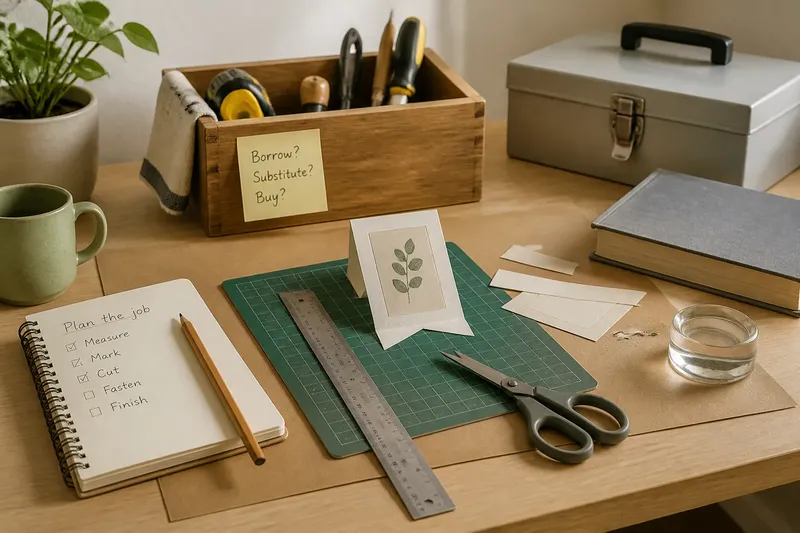
Break the job into actions: measure, mark, cut, hold, fasten, smooth or clean. Not every project needs every action. A folded-paper label might need a ruler, pencil and scissors; a loose cupboard knob might need only the screwdriver that fits its screw. This short action list reveals where a tool is essential and where a familiar household item could do the same modest job.
Also consider the material. Scissors that cut paper neatly may crush thick card; a blunt kitchen knife is not a safe stand-in for a craft knife. A screw’s head shape determines which driver fits it, while the softness and thickness of a material affect whether a clamp is useful. Read the project instructions and the tool maker’s guidance where relevant, and follow local rules for anything they cover.
For this approach, “small project” means a task with no structural, electrical, gas, chemical or other safety-critical work. If your plan crosses into that territory, stop treating it as a beginner’s tool-choice exercise and seek qualified help as appropriate.
When is borrowing the better choice?
Borrowing suits an occasional job that needs a particular tool, especially when you do not yet know whether the task will become a regular one. A neighbour may lend a hand drill for a small craft project, or a local tool library may have a hole punch, mitre box or set of screwdrivers. Ask for the correct accessory as well as the main tool: a drill without a suitable bit may not be useful.
Before you borrow, describe the material and the intended result. A person lending a tool can then say whether it fits the task and point out how it is meant to be held. Check that it is clean, intact and complete; return it in the condition agreed. If you are unsure how to operate it, ask for a demonstration or choose another route rather than guessing.
Borrowing is less attractive when the tool is awkward to transport, difficult to learn in the time available or needed repeatedly over a short stretch of work. It can also be a poor fit if the owner cannot spare it when you need it. In those cases, compare the inconvenience with the cost of buying, hiring or changing the project so it uses a tool already available.
Hiring is a useful middle option when a tool is specialised and a borrowing arrangement is not practical. It may suit a one-off task better than ownership, but check the hire terms, included attachments and return expectations before committing. Do not hire a machine simply because it sounds more capable than a hand tool; match it to the material, scale and instructions of the job.
When can a household substitute work?
A substitute is reasonable when it performs the same simple function without adding strain, slipping or damaging the material. A ruler can guide a pencil line on card. A flat, clean table can support a piece while you mark it. A heavy book can hold paper flat while glue dries, provided it will not be harmed by the adhesive or press on a delicate surface.
Improvisation is not a licence to use any object that happens to fit. A coin may turn a wide, shallow slot in a pinch, but it is a poor match for a small screw and may slip. Pliers are not a substitute for the correctly sized screwdriver when a screw head is easily damaged. Kitchen scissors should not be asked to cut wire, and a mug or glass is not a safe surface for cutting.
A useful test is to ask what would happen if the substitute moved. If it could cut your hand, send a sharp object towards you, crack the work or make you force the tool, stop and find a better option. For a low-risk substitute, hold the material steady, keep fingers clear of the cutting path and work on a surface that will not be marked. If you cannot control the tool comfortably, do not press harder to make it work.
Say you want to trim a loose paper edge on a small handmade label. You have a ruler and ordinary scissors, but no paper trimmer. You could mark the line with the ruler, place the label on a clear table and cut slowly with the scissors; the expected observable result is a tidy edge, even if it is not as mechanically straight as one made with a trimmer. If the paper is too thick for the scissors to cut without squeezing hard, borrow a suitable cutter or revise the design instead.
When is buying worth it?
Buying makes sense when the tool addresses a recurring need, is easy for you to store and use, and is suitable for the tasks you expect to do. A beginner who regularly makes paper labels may benefit from a comfortable pair of scissors with blades intended for craft materials. Someone assembling occasional furniture may need a well-fitting screwdriver more than a large mixed kit, though the correct driver still depends on the fasteners involved.
Think about the whole tool, not only the price tag. Check the handle, grip and control; consider whether the tool can be stored safely and whether any replaceable parts or attachments are easy to identify. A tool that feels awkward in your hand can discourage careful work. For items with moving parts or sharp edges, a clear storage place matters as much as the purchase itself.
Before adding a tool to your basket, name the next task it will serve. “I might need this someday” is not a job description. “I often cut fabric for mending and my paper scissors pull the fibres” points towards a specific need, though a dedicated pair should then be kept for that material. If you cannot name a plausible task, postpone the purchase and see whether the need returns.
Buying a small, suitable tool can also be preferable to repeatedly borrowing one that must be available at short notice. The value is not a promise of better workmanship; it is the ability to work at a pace and time that suits you. That benefit only counts if you know how to use the tool and can keep it in good condition.
Which option suits which kind of beginner?
Borrow when the job is unusual. This suits someone attempting a one-off task that calls for a specialised but familiar tool, such as a hand punch for a single card project. It keeps the home store small and gives the borrower a chance to understand what the tool does. It is a poor fit if the tool is unavailable when needed or its safe use cannot be explained.
Improvise when the task is simple and the substitute is controlled. This suits a person who already has ordinary household items and needs only to mark, support or hold lightweight material. It keeps a small project from becoming an excuse to buy a set. It is the wrong choice when the substitute slips, puts fingers near a sharp edge or needs force to work.
Buy when a repeated task has a clear tool requirement. This suits someone who has noticed the same need in more than one planned job, can store the tool safely and is ready to learn its use. A purchase can then be based on the material, fastener or action rather than the promise of a large collection. If the task remains vague, wait.
Imagine you plan to make several simple card dividers for a drawer. You already own scissors and a ruler, and the card is thin enough to cut without force. Begin with those. If you later make dividers often and want straighter repeated cuts, borrow a paper trimmer to see whether its method suits you; buy one only if that repeated need remains. The observable decision is not whether a bigger tool looks more professional, but whether it makes the recurring task easier to control.
How should you decide what to borrow, improvise or buy?
Do I need a tool for every action?
No. List only the actions the finished project requires, then look for a tool that fits each one. A job may need a measuring aid and a fastener tool but no cutting tool at all.
Is borrowing better than buying for a one-off task?
Often, if a suitable tool is available and you can learn to use it comfortably. If access is unreliable or the tool is unfamiliar, hiring, simplifying the project or asking a capable person to help may make more sense.
What makes a household substitute unsafe?
A substitute is a poor choice if it slips, breaks, damages the work or brings your hand into the path of a sharp edge. It should perform the same simple function without needing force or awkward handling.
How do I know whether a tool is worth owning?
Look for a specific task you expect to repeat, then check that the tool suits its material and fits your storage and handling needs. If you cannot name the task, leave the purchase for later.
How can a beginner avoid a drawer of unused tools?
Keep a short note of tools borrowed, improvised and bought, alongside the task each one served. This is not a catalogue exercise; it helps you spot whether a tool solves a recurring problem or simply seemed useful in the shop. After a project, note what was difficult: holding the material, making a straight mark or choosing the right driver. The answer may point to a tool, but it may instead suggest a clearer plan or a different material.
For a small, non-hazardous job, choose the least complicated option that gives you control: borrow for an occasional specialised need, improvise only when the substitute is genuinely suitable, and buy for a specific repeated task. That task-first approach to the tool collection trap leaves room to learn without asking a beginner to own a workshop before starting.