The Pencil Sharpener Before the Classroom Desk
Explore the pencil sharpener’s history through its blades, grips and shaving spaces, and learn what these details can suggest about where sharpening took place.
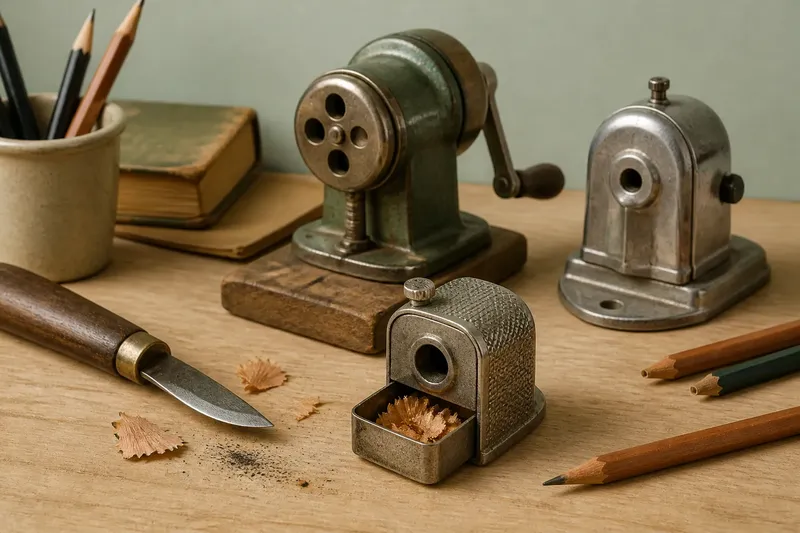
The common mistake is to picture the pencil sharpener as a classroom fixture from the beginning. The history of the pencil sharpener starts with a more basic act: trimming wood from around a graphite core, often with a knife. Its changing forms suggest different ways of doing that task, though an object alone cannot establish exactly when or why a particular design became common.
How were pencils sharpened before hand-held sharpeners?
A small knife could pare wood from a pencil and expose its graphite core. The user controlled the blade’s angle and the shape of the point, much as someone might shape a piece of wood with a knife. This required care and a suitable blade.
The method left room for different points. A broader point could suit shading; a finer one could make close marks. Shavings fell wherever the work took place, whether at a workbench, kitchen table or desk.
A knife was a general tool, not an object made solely for pencils. The existence of hand-held sharpeners shows that some makers and users wanted a device dedicated to the task. It does not, by itself, tell us when that preference took hold or what caused it.
What changed when the blade was built into the sharpener?
In a simple hand-held sharpener, the pencil passes through a shaped opening towards a blade set at an angle. The user turns the pencil while the fixed blade cuts. Unlike a knife, the tool helps constrain the cut rather than asking the user to guide a loose blade around the wood.
This design changed the gesture. The hand turned the pencil, while the opening and blade directed the cut. The compact tool could be brought to the pencil, rather than requiring a larger cutting tool.
A separate sharpener still had to be held, fetched and put away. In a basic design without a shaving compartment, the waste fell onto the work surface. Its convenience depended in part on the condition of its blade.
Why did sharpeners take different forms?
Portable sharpeners and fixed desk models answer different practical needs. A small sharpener can travel with a pencil and be held during use. A desk or bench model can stay in place, offering a stable base for repeated sharpening.
On a hand-cranked model, the user turns a handle while a holder keeps the pencil in position. The mechanism shifts the effort from turning the pencil itself to operating the crank. A container beneath the cutting parts can gather shavings, though it needs to be emptied.
These forms should not be treated as a simple sequence in which each new design replaced the last. A pocket sharpener and a fixed model can serve different places and patterns of use. Their features suggest intended settings; they do not prove who owned them or how often they were used.
What can an old pencil sharpener tell you?
Inspect the opening, blade, grip, base and shaving space together. Each can offer a clue about how the sharpener was meant to be held or placed, but no single feature settles its history.
- Opening: Observe whether there is one pencil-sized hole or several. If there is one, treat it as a clue to a single opening size; if there are several, consider that the design may accommodate different pencil shapes or widths.
- Blade position: Observe whether a blade sits beside the opening or connects to a crank mechanism. If it sits beside the opening, the pencil was likely turned by hand; if a crank and holder are present, consider use on a stable surface.
- Grip: Observe whether the body is small and easy to hold or broad enough to rest on a surface. If it is shaped for the hand, consider portable use; if it has a broad base, look for other evidence before deciding it was intended to stay put.
- Shaving space: Observe whether the sharpener has an open cutting area or a built-in compartment. If it is open, expect shavings to need separate collection; if it has a compartment, check how it opens before deciding how waste was removed.
- Mounting points: Observe the underside for holes, clamps or other attachment features. If present, consider a fixed mounting position; if absent, do not assume the sharpener was portable without checking its shape and base.
- Wear: Observe rounded edges, worn handles or marks around the opening. If wear is visible, treat it as evidence of handling; if it is absent, do not infer that the sharpener was unused, since parts may have been replaced or cleaned.
Say you find a metal sharpener with one pencil opening, a small body and no crank. Its underside has no mounting holes, and a separate compartment catches the shavings. Those observations point towards a hand-held design that contains its waste; they do not identify an owner, a date or a specific place of use. If the compartment is jammed, check its opening gently before trying to remove it, rather than forcing a part that may be fragile.
What do people ask about the pencil sharpener’s early forms?
Did people sharpen pencils with knives?
A knife could pare away the wood around a pencil’s graphite core, with the user controlling the point’s shape. It was a general cutting tool used for a pencil task, not a device dedicated to pencils.
Why does a hand-held sharpener have a hole?
The opening holds the pencil against a blade set at an angle. Turning the pencil lets the fixed blade cut without requiring the user to guide a loose blade along the wood.
How does a desk sharpener differ from a pocket sharpener?
A desk model is designed to rest or be fixed in place, and a crank can operate its cutting mechanism. A pocket sharpener is held by hand and travels more readily with the pencil.
Can wear reveal who used an old sharpener?
Wear can suggest that an object was handled, but it cannot identify a particular user or location. Read it alongside the sharpener’s construction, and leave details uncertain where the object provides no evidence.
What does the pencil sharpener’s history reveal about its design?
The pencil sharpener’s history can be read through the task each form makes easier: guiding a blade by hand, turning a pencil against a fixed edge, or operating a mechanism anchored to a desk. These designs offer clues about practical choices, not a complete chronology of changing habits.
When examining an old sharpener, turn it over before deciding where it belonged. A mounting point, a shaving compartment or a smooth hand-sized body may help explain how it was intended to be used. If the object lacks a clear clue, recording what you can observe—and what remains uncertain—is a more reliable account than assigning it a precise date or setting.