Why Wood Grain Runs in Different Directions
Why wood grain runs in different directions affects splitting, rough edges and how a board feels in use; learn what to look for before choosing timber.
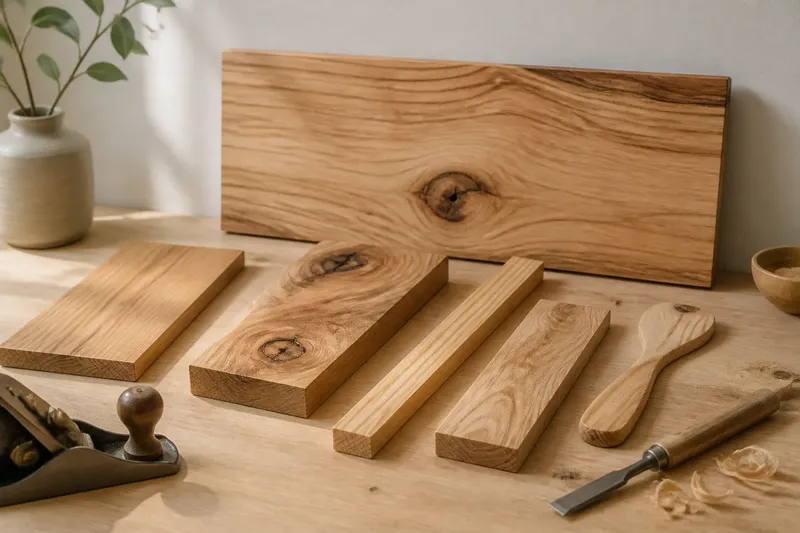
The common mistake with a small wooden project is treating a board as if its surface were uniform. Wood grain runs in different directions, and that can turn an ordinary cut or a rubbed edge into a ragged patch, a split or a surface that feels rough in one direction. Reading the grain before choosing a board helps you anticipate how it will respond to the handwork your project needs.
Why does grain direction change how a board behaves?
A tree grows by laying down long fibres along its trunk. In a sawn board, those fibres usually run lengthwise, but the visible pattern also reflects how the log was cut and how the tree grew. Knots, bends and interlocking fibres disturb the otherwise fairly straight lines.
Think of the fibres as tiny straws packed together. A tool moving along them can skim over their ends and leave a clean surface. Moving against them may lift or tear some fibres instead. This is why a board can feel smooth when rubbed one way and scratchy when rubbed the other.
There is no single grain pattern that suits every project. A small shelf support, a hand-cut toy part and a shallow tray each ask different things of their wood. The useful question is whether the grain’s direction and interruptions fit the shape and the work you plan to do.
Why does a cut edge turn rough or splinter?
A rough edge often appears where fibres are cut across rather than supported by neighbouring fibres. If a knife, chisel or saw meets a section that slopes towards the surface, it can prise up a thin wedge instead of slicing the fibres neatly. The defect may look like a sudden change in wood quality, but the grain can be the cause.
Look at the board’s edge as well as its broad face. A line that appears to run straight across the face may slope through the thickness. That slope can help explain why a cut behaves differently at one end. On a small project, a sharp pencil line and a close look under good light can reveal enough to choose a better part of the board.
If a surface becomes rough during hand-planing or paring, pause rather than pushing harder. Turn the work around and try the tool in the opposite direction on a hidden area or an offcut. If the fibres lie down more cleanly, continue with the easier direction; if they still lift, use a lighter pass or choose a section with straighter grain.
Why does a split travel away from the line?
Wood often splits along the length of its fibres, so a crack can wander with the grain rather than obeying a pencil mark. A narrow piece with a knot or a sharply sloping grain line is especially likely to divide along a path that is not the intended edge. The split is not necessarily a sign that the board is brittle throughout.
For a simple project, inspect the planned cut lines before committing to them. If a grain line runs out through the edge near a corner, that corner may be vulnerable to breaking away. Shifting the shape to a calmer section, or changing its orientation so the fibres support the narrow part, can reduce the chance of a stray split.
Say you are choosing a scrap for a small wooden bookmark. One candidate has a knot close to the narrow tip, with grain lines bending towards the side; another has a plainer, more even pattern. Choosing the second piece gives the tip more continuous fibres to support it, so it is less likely to chip during shaping or ordinary handling.
How can you choose a board by reading its grain?
Start with the shape of the finished piece. Long, narrow parts benefit from fibres that run along their length, while a broad, shallow piece can tolerate more variation if its edges remain sound. Look for lines that continue through the area you intend to use, and note where knots or abrupt changes interrupt them.
- Follow the face grain: Check whether the visible lines run broadly with the length of the proposed part or sweep towards an edge.
- Check the board’s edge: Look for grain that slopes sharply through the thickness, especially near a narrow end or corner.
- Inspect knots and bends: Decide whether an interruption falls inside a section that needs to stay strong and clean-edged.
- Rub the surface lightly: Feel for a direction that is smoother and notice where the texture changes around a knot.
- Match the grain to the task: Prefer steadier, lengthwise fibres for slender pieces that will be handled or shaped along their edges.
These checks do not require a perfect board. A small project can often be laid out to avoid a troublesome patch, and visible grain variation may be welcome where appearance matters more than a crisp edge. The aim is to notice the board’s likely behaviour before cutting it to a shape that leaves no room to adjust.
What do readers usually ask about wood grain?
Which way should I plane with the grain?
Try to move the plane so its blade cuts fibres that lie down rather than lifting towards the surface. On a board with changing or interlocking grain, the easiest direction may change from one area to another, so use light passes and watch the surface.
Does straight grain always make the best board?
Straight grain is often easier to shape cleanly, particularly in a narrow part, but it is not automatically the best choice for every object. A wider piece may use a more varied pattern if the grain does not undermine its edges or the parts that will be handled.
Can I tell grain direction from the broad face alone?
The face gives useful clues, but it can hide how the fibres slope through the board. Check an edge too, and treat a knot or sudden curve as a sign that the grain may change locally.
Why does the same board feel smooth one way and rough the other?
Rubbing against the fibre direction catches raised ends, while rubbing along them tends to press those fibres down. The difference is especially noticeable where grain bends around knots or crosses the surface at an angle.
What should you do when the grain changes mid-piece?
A board’s grain is rarely a perfectly straight map from end to end. A tree’s growth and the way its timber was sawn can leave fibres that curve, cross or emerge at the surface. Treat each changed area as a local condition: a tool direction that worked along one stretch may begin to tear fibres beyond a knot.
When the project allows it, keep the most vulnerable feature away from a sharp grain turn. If the piece is already cut, orient it so the smoother grain direction is the one most likely to meet the hand, and avoid forcing a tool through a patch that is lifting. A small offcut from the same board can help you read how its fibres respond before you work on the visible surface.
Wood grain direction is not merely decoration. It is a practical clue about where a board may cut cleanly, where a thin section might split and which way a surface is likely to feel smooth. For a simple household project, choosing the part of the board whose fibres support the shape is often more useful than choosing the most striking pattern.